Water Mold Fire Mitigation scoping, built for the people who do it.

Get paid what you billed.

Unless you change from opinion to defensible fact, you’ll always get your invoices cut.

Start Trial

Card required. Seven days, nothing charged until they’re up. The first thing you see is a completed loss — read it before you enter a fact of your own.

The promise

He always gives you a reason. The reason is an opinion.

Two opinions cancel nothing. His is the one attached to the check.

A citation is not an opinion. It is the standard his own industry published, and the code your city adopted.

He can hold any position he likes. He cannot hold one against a citation without writing down why.

STEP 01

Your tech answers our mitigation survey

The reading, the material, where the water went. Observations. Never conclusions.

Our survey covers every aspect of a mitigation scope, rooms separated by affected areas. It couldn’t be easier.

STEP 02

The scope builds itself

Same facts, same scope, every time. Every line carries the standard that requires the work — and your local law, where your city adopted it.

STEP 03

You send your defended scope

Our scope is already defended, but sometimes you can lead a horse to water — you just can’t make him think. That’s where rebuttals get fun. Since Scope Engine has already done the hard work, every rebuttal tightens the authority behind your scope.

What changes

Three things change on the first file you send.

Get your prices paid

The reason a line is owed travels with the line. It stops living in your head.

Price with authority rather than opinion

Every line names the standard that requires the work. A line that cannot name one is flagged on the face of the estimate. Never quietly billed.

Enjoy rebuttals, because they create your unfair advantage instead of being a pain in the neck

The answer is written before he asks. His cut lands on the record beside your proof, and you send it without writing a word.

The shop that runs it

“This saves so much time. We can scope all of our mitigation jobs in 20 minutes and send the file before we ever have a piece of equipment on site.”

Justin Stoltman — Heartland Restoration, Kansas City

ServiceReady owns Heartland Restoration, and Justin runs it. Both files below are ours, and we say so. Justin will take a call from anyone who wants to check that.

$9,914.97 Travelers — submitted defended, paid in full. No line omitted, no line reduced, no reinspection.
$3,989.00 Liberty Mutual — they cut thirteen categories first. Three rounds, all in writing. Paid to the penny.

Mitigation only — the engine scopes mitigation, not build-back. Two files, not a promise about your claim.

Two real files

Citations aren’t a silver bullet — your file has them and still gets ignored.

You read a Facebook post that said you should cite standards. That’s good advice, but it is only informative — it is not helpful.

The adjusters do not know the standards and are not looking at the files. They have outsourced that to third-party administrators like WardLaw. You have to frame lawful, factual citation and evidence that cannot be argued with. QuickBooks and muddy scopes will never get you there. Only Scope Engine’s deterministic scope with the authority attached can.
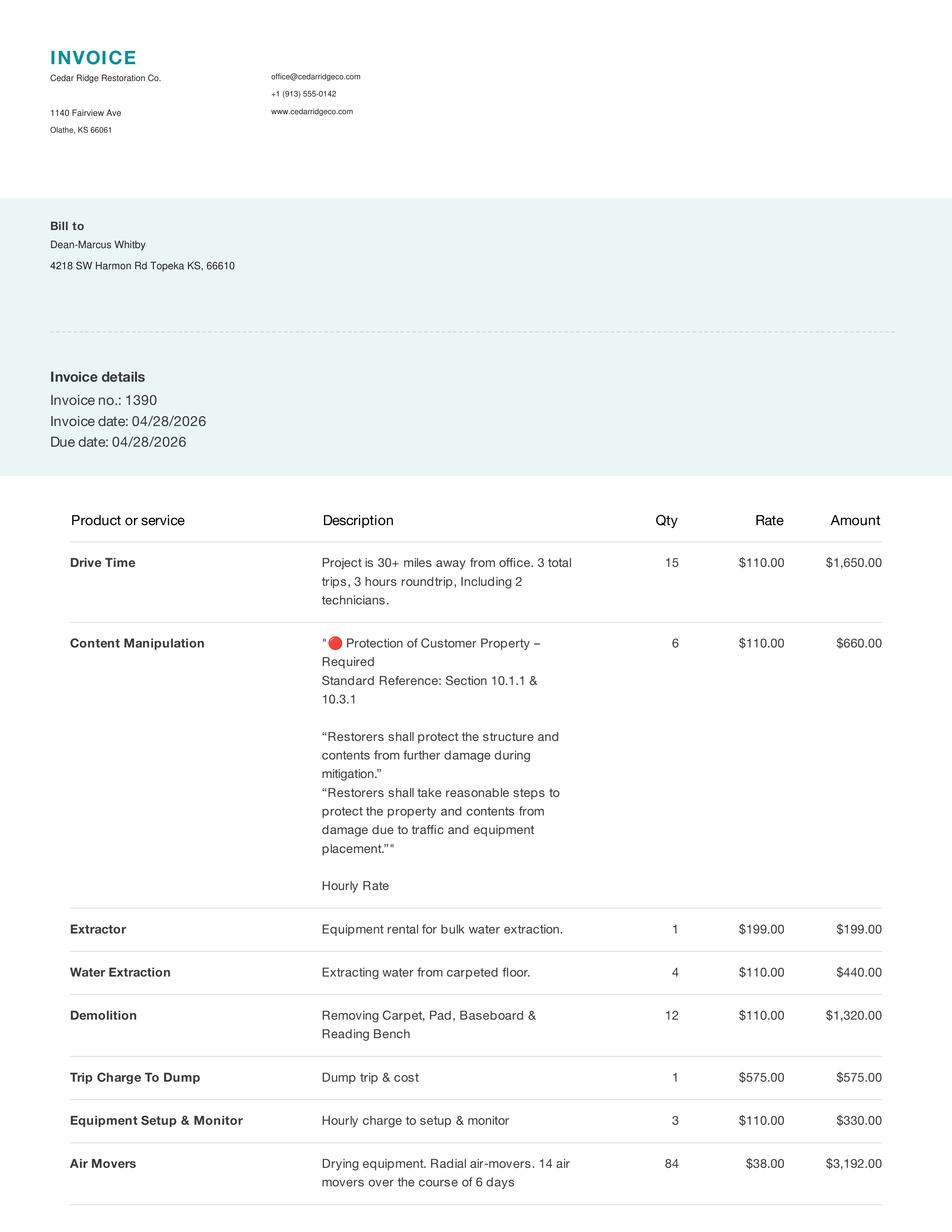
What you send nowThe invoice
A restoration invoice. Line items with quantity, rate and amount. The published standard is typed into a description box as free text.

Page 1 of 2 · the standard, in a description box

Hover to magnify

  • 1You already did the right thing. S500 §10.1.1 is quoted here, in a description box, in quotation marks. Nothing ties it to a measurement. Nothing proves the condition it applies to. Delete the line and the argument goes with it.
  • 2Six hours at $110. Nothing on this page says where six came from, so there is nothing to disagree with except the number.
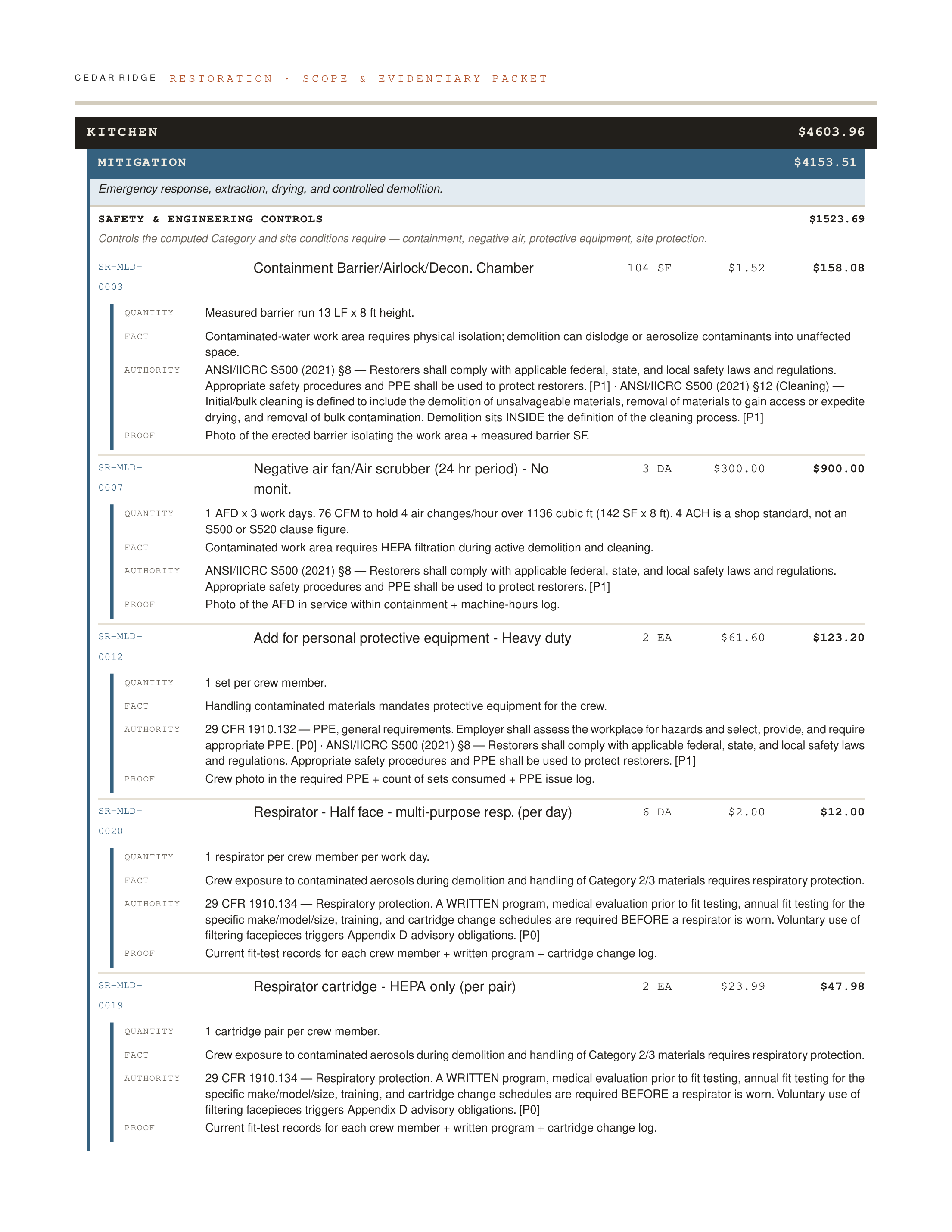
What the engine sendsThe Scope Engine packet
Priced scope items grouped by area, each line carrying its quantity math.
Page 13 of 98 · the priced scope
  • 1The same trade, priced by area. Every quantity on this page is computed from a recorded measurement, not typed in. Disagreeing with the number now means disagreeing with the measurement.
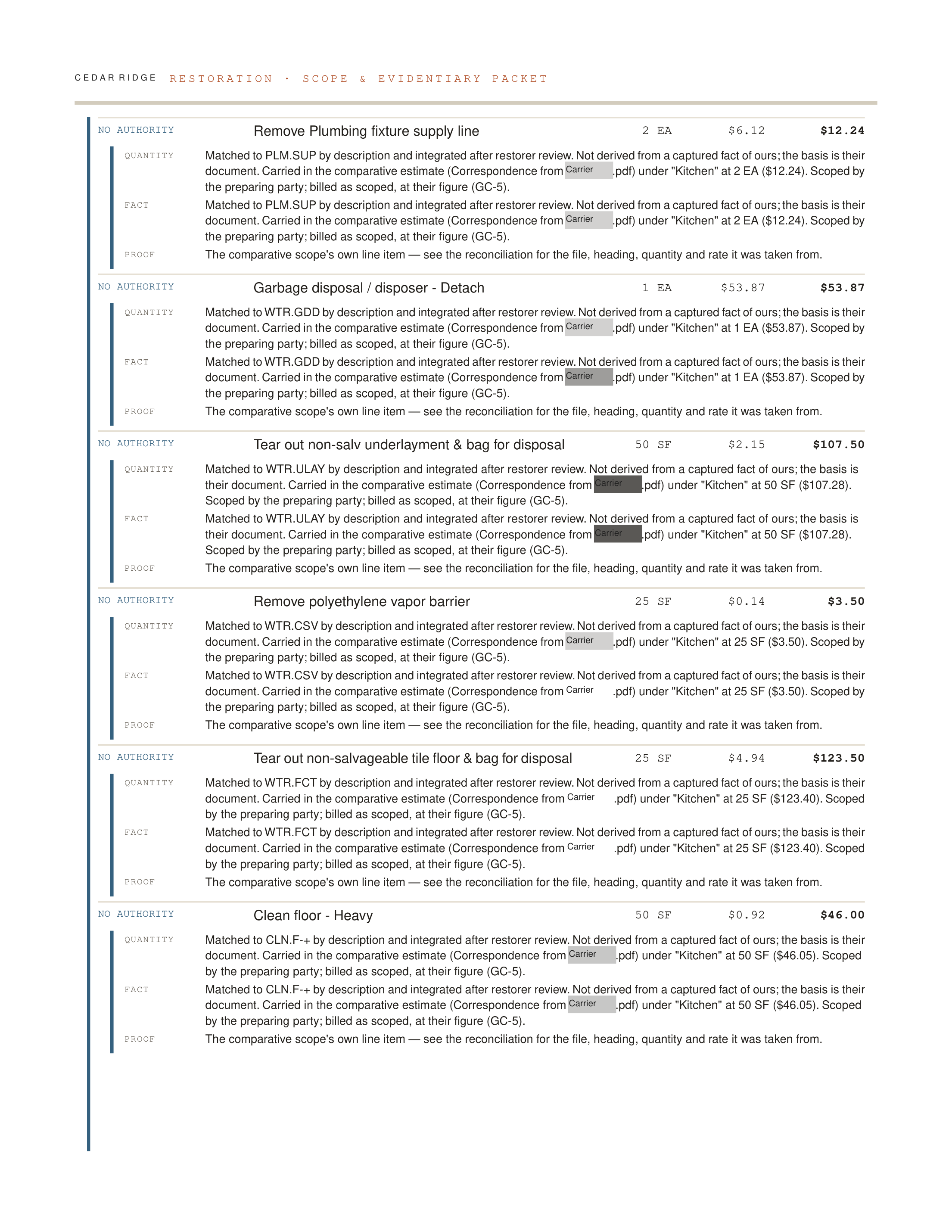
Six line items stamped NO AUTHORITY, each stating that the basis is the carrier's own document rather than a captured fact.
Page 19 of 98 · the lines it refuses to claim
  • 2NO AUTHORITY, printed on the face of the estimate. The software will not claim these lines as its own finding, and it says so before the adjuster can find it himself.
  • 3Billed at their figure, from their document, labelled as theirs. There is nothing here for him to catch, because it has already been disclosed.
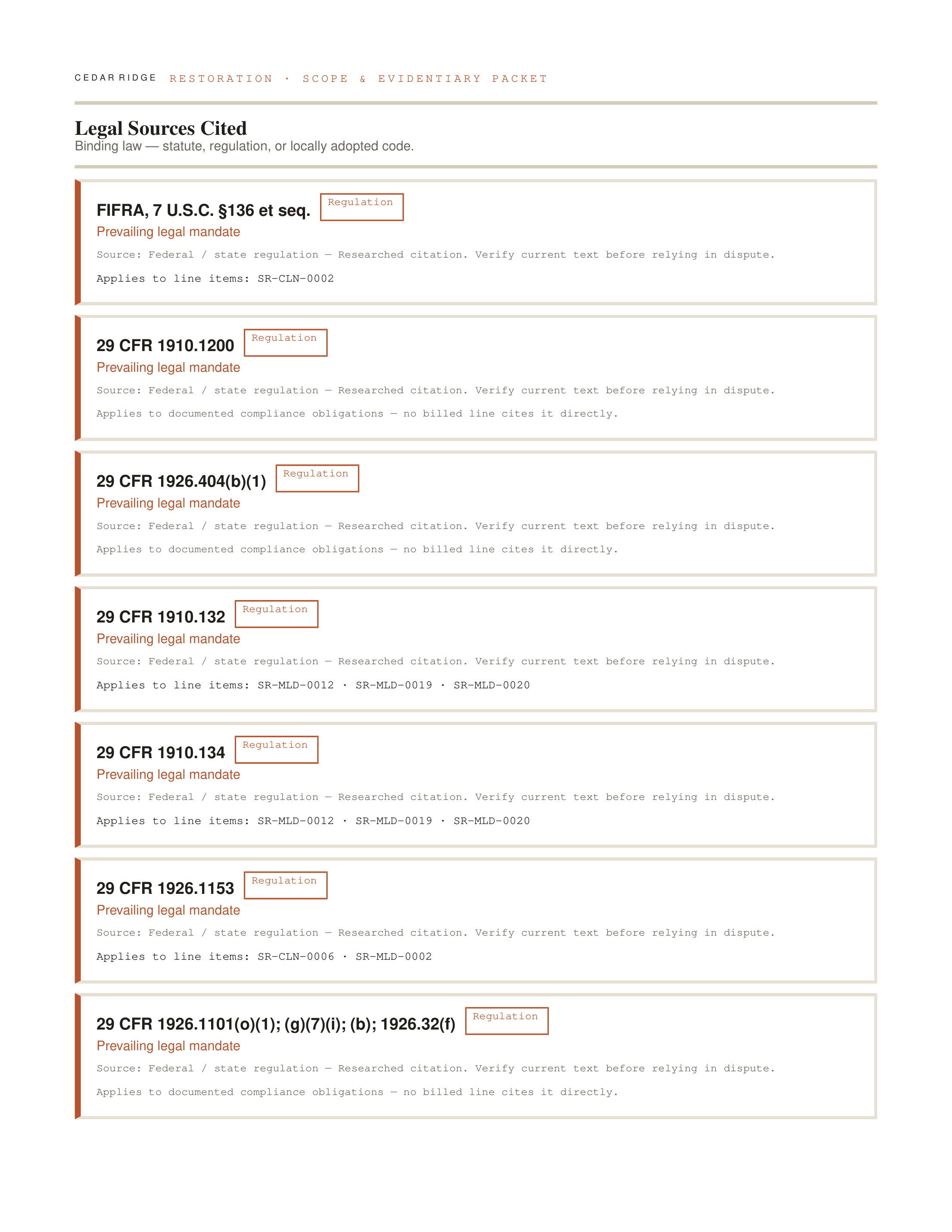
Legal sources cited, with binding law listed separately from recognized standards of care.
Page 42 of 98 · law kept separate from standard of care
  • 4Binding law on one side, recognized standard of care on the other. Nothing is claimed as law that isn’t — which is the part that survives a lawyer reading it.

Hover to magnify

Two pages against ninety-eight. You are looking at three of them, because three is as much as a web page can usefully hold.

Both documents are ours. Names, addresses, letterhead and the carrier have been removed from both. Read the whole thing first if you would rather.

Have a claim you want to compare?

Give us your email and phone number and we’ll set up a time to go over it with you. Once you enter the form we’ll send you this sample packet.

Ninety-eight pages, emailed as a PDF. We use the number to arrange the walkthrough, nothing else.

Sent. The packet is on its way to your inbox — check spam if it is not there in a minute. We’ll be in touch to set up the walkthrough.

FAQs

Questions we get asked.

Is citing standards at an adjuster even allowed?

It is his own industry’s published standard, not your reading of anybody’s policy. Scope Engine documents work and conditions. It does not interpret policy language, characterize coverage, or advise anyone on their claim — that boundary is deliberate and it is enforced in the product.

What if they cut it anyway?

Liberty Mutual did — thirteen categories deep. The answer was already written, the exchange happened in print, and the scope was paid to the penny. You stop defending a total from memory, on the phone, at seven at night.

Does this replace the estimating software I already use?

No. It writes the line item descriptions you already work in. It makes each line defensible before it leaves your office.

What happens in the first seven days?

A card is required. Nothing is charged until the seven days are up. The first thing you see is a completed loss — a full, cited packet, read end to end before you enter a fact of your own.

Stop sending opinions.

Unless you change from opinion to defensible fact, you’ll always get your invoices cut.

Start Trial

Card required. Seven days, nothing charged until they’re up.

See everything Scope Engine does